
The Collaboration That Made It Possible
Before Striking 12 found its audience, something had to come together that almost never does in independent theatre: the right writers, the right performers, and a structural idea so clean it looked inevitable in hindsight. GrooveLily — the New York trio of Valerie Vigoda (electric violin and vocals), Brendan Milburn (keyboards and vocals), and Gene Lewin (drums and vocals) — had been honing their genre-blending rock-folk-jazz sound since the mid-1990s. They were a band who had always told stories, who had always written songs with an eye toward character and situation. Striking 12 was the moment that storytelling instinct found the perfect vessel.
Their co-author on the book was Rachel Sheinkin, a collaborator with serious theatrical pedigree: she had written the book for The 25th Annual Putnam County Spelling Bee, the cult off-Broadway hit that transferred to Broadway and became one of the defining indie-theatre success stories of the 2000s. With Sheinkin shaping the show's dramatic architecture and GrooveLily supplying a score that slid between rock anthem, jazz groove, and something tenderly, unexpectedly intimate, Striking 12 had both the structural intelligence and the musical muscle to work. The collaboration produced something that neither party could have made alone — a book musical with a pop-band heartbeat.
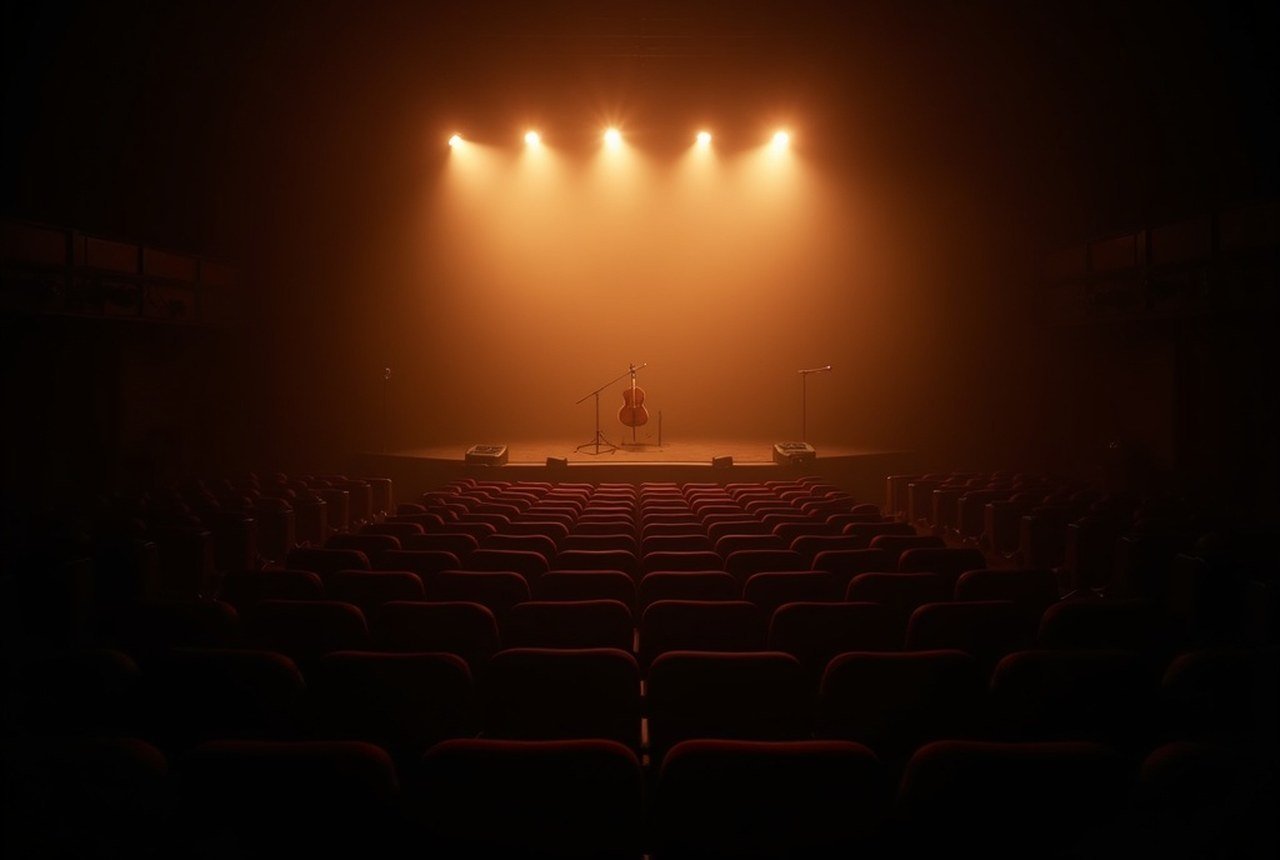
The premise is, on paper, almost disarmingly modest: a man who doesn't want to celebrate New Year's Eve, a woman selling holiday light bulbs, and a fairy tale threaded through the middle of it all. But modesty of premise has never been the same thing as smallness of ambition, and Striking 12 earns every emotional note it reaches.
Two Stories, One Stage
The show's structural conceit is where it gets genuinely clever. Vigoda, Milburn, and Lewin don't just perform Striking 12 — they narrate it, inhabit it, and comment on it, often within the same breath. The three of them are simultaneously the band providing the score, the cast playing the characters, and the narrators guiding the audience through two interlocking stories that span a century and a continent before resolving in a single, intimate New Year's Eve encounter.
“The collaboration produced something that neither party could have made alone — a book musical with a pop-band heartbeat.”
The contemporary story follows a man nursing a fresh breakup, grimly determined to sit out the holiday in the most thoroughgoing way possible. He is not celebrating, he is not connecting, and he is emphatically not interested in hope — a stance that is both recognisably human and gently, persistently funny. Then a young woman selling holiday light bulbs appears and begins, despite his best efforts at misanthropy, to make a dent.
Woven around and through this story is Hans Christian Andersen's The Little Match Girl — the 19th-century tale of a street seller in the winter cold, trying to sell her matches, lighting them one by one for warmth and vision. The parallels are not spelled out so much as allowed to rhyme: a seller in the cold, small flames of hope, the thin membrane between connection and isolation. Andersen's original is one of the bleaker entries in the fairy-tale canon, and part of Striking 12's quiet achievement is the way it holds onto that darkness even while it navigates its contemporary story toward the light. The show does not pretend the world is easier than it is. It just argues, with considerable wit and musical ingenuity, that light bulbs — and, by extension, connection, and generosity, and the stubborn human habit of trying — are worth something.
The structural device that makes all this work is elegant in the way that only genuinely well-engineered things are: the same three performers carry both timelines, and the genre-blend of the score — rock here, something waltz-adjacent there, jazz undercolouring everywhere — maps the emotional terrain of both stories simultaneously. When the two threads converge, the effect is not just dramatically satisfying but almost architecturally pleasing. You can feel the pieces clicking.
The Band as the Show
What makes Striking 12 distinctive on the page becomes, in live performance or on the cast recording, genuinely thrilling in practice. Three performers. A full theatrical evening. No pit orchestra, no ensemble, no supplementary musicians. Just Vigoda's electric violin, Milburn's keyboards, and Lewin's drums — and the collective vocal and dramatic weight that all three bring to bear across every scene.
Vigoda's electric violin is not a texture or an accent — it is the show's primary melodic voice, the instrument that carries the fairy-tale thread with something close to aching, and then in the next moment drives the rock energy of the show's bigger moments. She plays the instrument with the kind of committed physicality that makes the electric violin not just plausible in a rock-folk-theatre context but completely, irresistibly right. Vocally, she moves between characters and narrative modes with a fluency that is easy to admire and difficult to pull off.
Milburn's keyboard work provides the harmonic and rhythmic sophistication that keeps the show's genre-blend from ever feeling arbitrary. His vocal contribution runs the full range from the show's drier, more wryly observational moments to a raw power that lands, in the show's darker passages, with real weight. The songs he and Vigoda wrote together for Striking 12 — she writes lyrics, he writes music — are constructed with the economy that only people who have spent years on the road together can achieve: nothing is excess, every hook earns its place, and the emotional payoff, when it comes, feels earned rather than manufactured.
Lewin's role is often the hardest to talk about and the most immediately felt in the room. Good drumming in a theatrical context does what the best theatrical drumming always does — it holds the comic timing together, marks the emotional pivots, and keeps the whole thing from feeling like chamber music when the show wants to rock. Lewin does all of that, and the comic dimension of his performance is its own pleasure: the dry delivery, the deadpan interjection, the sense that the drummer has opinions about this story and is not going to keep them entirely to himself.
The looping technology that GrooveLily have employed throughout their career — layering live-recorded phrases through a loop pedal so that three players can fill a space built for many more — is, in Striking 12, not a gimmick but a genuine dramaturgical tool. The show sounds full because it is full: full of craft, full of intent, full of three musicians who have been making music together long enough to hear each other thinking.
Why It Still Matters
Striking 12 premiered off-Broadway, in the smaller-house New York professional theatre world where GrooveLily had built their reputation, and it found the audience that independent theatre at its best always manages to find: people who wanted something real, something funny, something with a story that didn't condescend to them. The cast recording made the show accessible to listeners far beyond New York, and it remains the clearest single document of what GrooveLily can do when every element of their practice — the genre-blend, the story-song instinct, the live performance energy, the compositional craftsmanship — is working at full stretch.
It would be easy, at this point, to say that Striking 12 changed everything for GrooveLily by opening doors, and that is true. It demonstrated that the band's theatrical instincts could sustain a full evening, that the three-person format was a feature rather than a limitation, and that indie theatre had room for something that sounded like a rock band playing a fairy tale at midnight. The shows that followed — Sleeping Beauty Wakes, and later Ernest Shackleton Loves Me, which Vigoda and Milburn wrote together — built on the structural and musical confidence that Striking 12 established.
But the more important truth about Striking 12 is not what it did for the band's trajectory. It is what it does, still, every time someone puts on the cast recording on the last evening of December and hears a man who doesn't want to celebrate slowly, reluctantly, convincingly change his mind. The show makes its case not through spectacle or scale but through exactly the qualities that make GrooveLily worth following in any context: precision of craft, generosity of spirit, and the kind of writing that trusts an audience to feel something without being told what to feel.
Stripped to its essentials — three performers, two interlocking stories, one unforgettable New Year's Eve — Striking 12 is exactly what musical theatre can be when the people making it care more about the work than about the machinery surrounding it. It is, for a show about a man who wants to be left alone, extraordinarily good company.
The story, in brief
- mid-1990sGrooveLily (as The Valerie Vigoda Band) begins developing their sound in New York
- 2000sStriking 12 premieres off-Broadway; cast recording released
- post-Striking 12Sleeping Beauty Wakes and Ernest Shackleton Loves Me follow, building on the theatrical template
GrooveLily is an unofficial fan tribute. We have no affiliation with the band, their management, or any label.