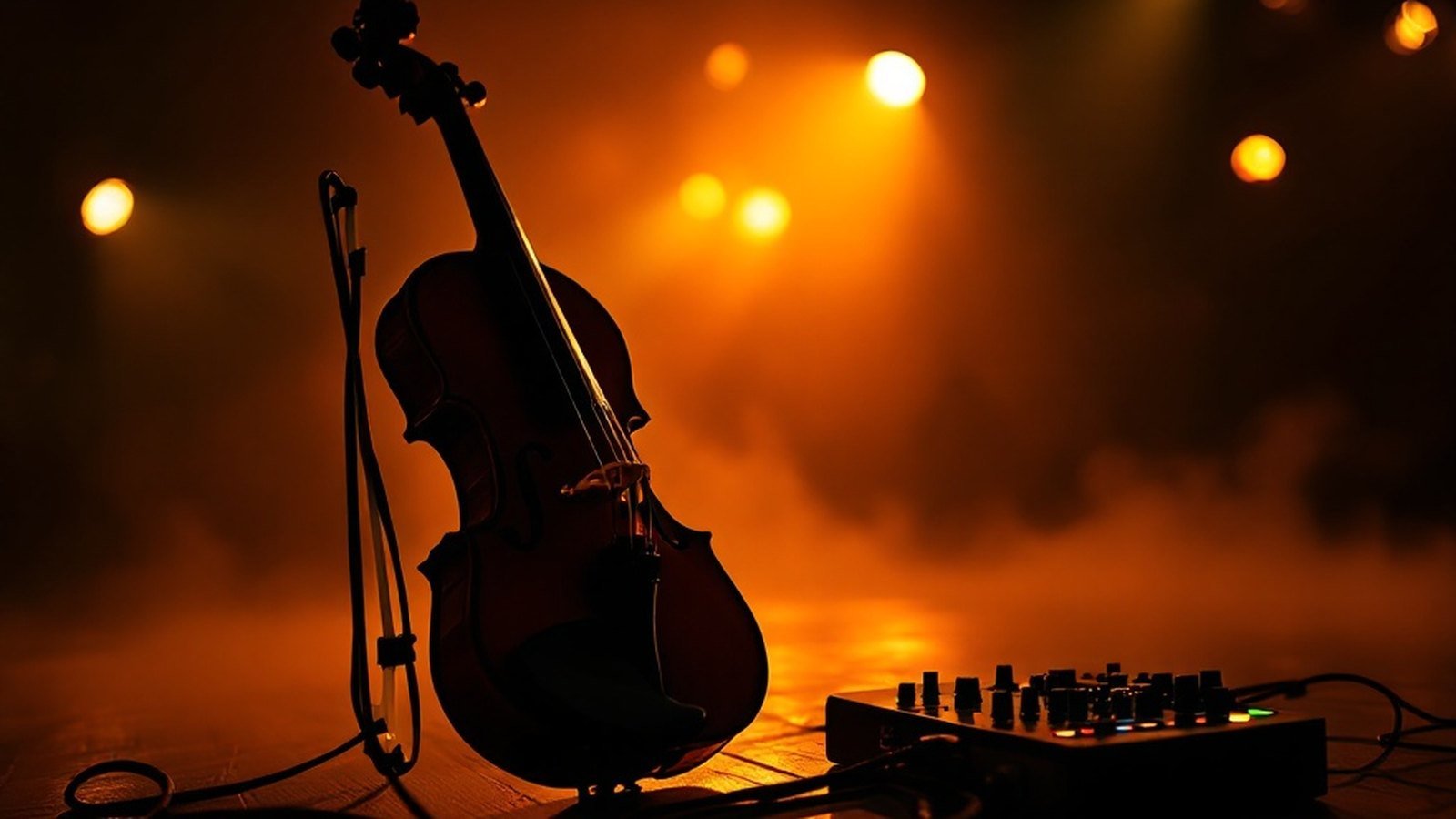
Why Vigoda's amplified fiddle isn't just an instrument — it's the whole argument.
There's a moment in almost every GrooveLily live performance — a moment seasoned fans learn to anticipate — when Valerie Vigoda steps to the loop pedal and begins to build. A phrase locks in. Then another lands on top of it. Then a third. What started as one electric violin becomes a shimmering wall of interlocked melody, and suddenly the room understands that this three-piece outfit is somehow producing the density of an ensemble twice its size. That's not a studio trick. That's Vigoda, her instrument, and a set of skills honed across three decades of refusal to play it safe.
The electric violin is the spine of the GrooveLily sound, and it's worth sitting with how genuinely strange and genuinely thrilling that is. The violin has centuries of classical pedigree behind it and a long folk tradition beside that, but it has never been the natural center of rock — not the way the guitar is. GrooveLily made it the lead voice anyway. Vigoda plays the instrument with the attack and authority of a rock guitarist, bending the conventions of both worlds and producing something that belongs entirely to neither.
The Instrument Itself
An electric violin looks something like its acoustic cousin but behaves like a different creature altogether. Without a traditional resonating body, it relies on a pickup to convert string vibration into signal, which then travels into amplifiers, effects pedals, and — crucially, in Vigoda's hands — a looper. The result is an instrument with enormous dynamic range and a tone that can be warm and lyrical one moment, then slicing and urgent the next. That flexibility matters enormously in a band whose songs move between tenderness and full-tilt rock within a single verse.
“An electric violin looks something like its acoustic cousin but behaves like a different creature altogether.”
Vigoda is a classically trained violinist who came up through that world before following her own ear somewhere far more interesting. The technique she built in those early years is still audible — the intonation is precise, the bow control meticulous — but it's deployed now in service of a completely different aesthetic. She writes the band's lyrics, sings lead, and plays the melody, the countermelody, and sometimes the rhythm part simultaneously. In a conventional band, those functions get distributed across multiple players. Here, she holds them together herself.
Looping as Composition
The loop pedal is worth special attention, because Vigoda doesn't use it as a gimmick. Looping — the live layering of recorded phrases so a small number of players can generate a full-band sound — is a technique that can easily become a party trick. In GrooveLily's hands it's closer to real-time composition. Each loop is placed deliberately, with attention to where it sits in the arrangement and how it interacts with Brendan Milburn's keyboards and Gene Lewin's drums. The effect is additive in the best sense: the room fills up gradually, and by the time the loop stack is complete, the song has arrived somewhere it couldn't have reached any other way.
This approach also means that no two GrooveLily performances are identical at the level of texture. The loops are built live, in the room, with the response of the audience and the acoustics of the space folded into them. It's live music in the oldest sense — present-tense, irrepeatable — and the electric violin is the mechanism that makes it possible.
Why It Matters for the Theatre Work
When GrooveLily moved from rock trio to indie-theatre makers — writing story-driven book musicals like Striking 12, Sleeping Beauty Wakes, and Ernest Shackleton Loves Me — the electric violin came with them, and it turned out to be exactly the right instrument for narrative songwriting. The violin has always been the instrument that sounds most like the human voice. In a musical-theatre context, that quality is irreplaceable. Vigoda can play a melodic line that echoes, answers, or undercuts the lyric being sung, creating counterpoint that a guitar or keyboard simply wouldn't produce the same way.
Three players, one amplified fiddle, and thirty years of working out what it can do. That's the GrooveLily proposition — and it's still as good as it ever was.
GrooveLily is an unofficial fan tribute. We have no affiliation with the band, their management, or any label.